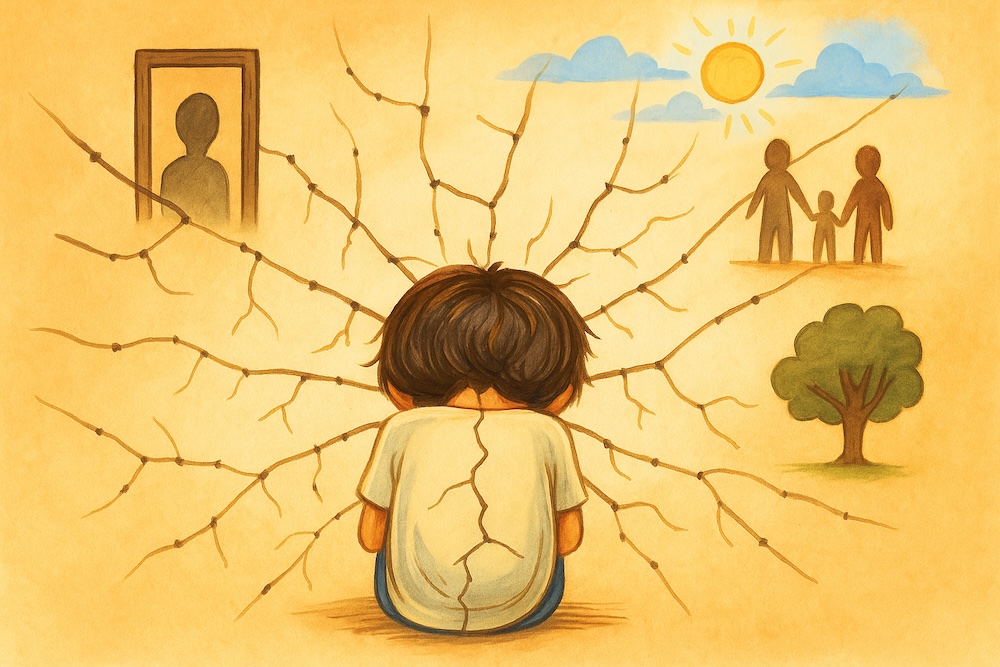
Stop chasing compliance and start building skills (and regulation)!!
This workshop-style training is intended for:
📌 Educators – administrators, school psychologists, classroom teachers, school counselors, educational assistants, etc. wishing to gain knowledge, skills and a system for creating FBAs and behavior plans that honor the nervous system and brain, and prevent harm from students who are alredy suffering most, and
📌 Parents or advocates wishing to become equipped with the knowledge and skill to frame up why their student a) needs a behavior plan in some cases, or b) needs a different type of behavior plan when the traditional plan(s) haven’t been working or may even be re-traumatizing
Participants will experience a combination of didactic instruction, visuals, and examples, followed by hands-on creation of a plan to take back to their particular setting (educators) to implement with students who struggle due to trauma impacts, neurodivergence, or other causes of chronic undesirable(often termed challenging) behavior, or to their student’s team (parents/advocates) as an example of the kind of plan that will avoid triggering or harming them and instead, produce lasting results.
What’s to be gained through training on this Trauma-Informed FBA?

I was so excited to stumble upon this training…. the title alone drove my excitement! (I was literally googling Trauma Informed BIP’s for help) I’ve spent the first half of the year trying to get people to understand that a typical FBA and BIP is not a magic wand for students affected by trauma. Typical function of behavior does not apply. It was wonderful to spend my Saturday learning from you.
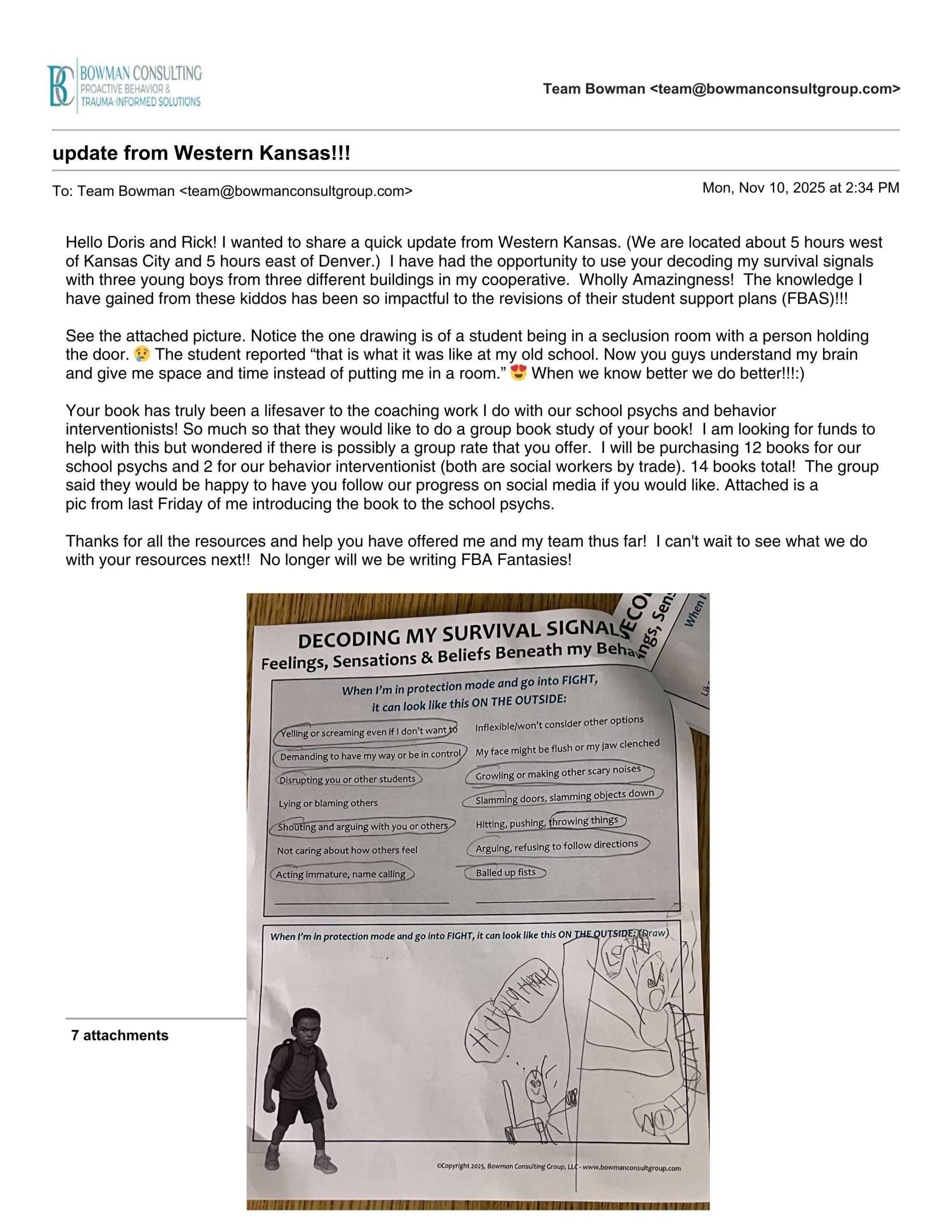
As a BCBA, I came into this training hesitant on the content I was about to listen in on, and about 35 minutes into this training, I became enthralled with the materials, intrigued with the neural pathways of how the brain operates under stress and learning the ideas of “tweaking” of past and present protocols to encompass this new approach to supporting students. I recommend this training to all school staff, & actually anyone working with humans to attend, and in fact this can be a great onboard training. To my surprise I thoroughly enjoyed all the material presented.
Who can benefit from the use of Trauma-Informed FBAs & BSPs?
Rick and Doris are 2 extremely knowledgeable professionals. This workshop is extremely organized and thorough. I am thrilled that I participated today.

Other benefits gained from this Trauma-Informed FBA training:
This training was so helpful as a behavior specialist who conducts FBAs and writes BSPs! It took the idea of “trauma informed practices” and gave me concrete ideas (and the rationale behind using them) to incorporate into my FBA process.
This training is student-centered and connects collaborative problem solving with writing a trauma informed FBA and BSP for our students who are living with or have experienced trauma.
This was such a fantastic course, it was so informative and I learned concepts I had never heard of. I loved how it was organized and loved all the visual aids. The practical portion of the skills assessment and the FBA template was so great.
Meet Our Trainers:
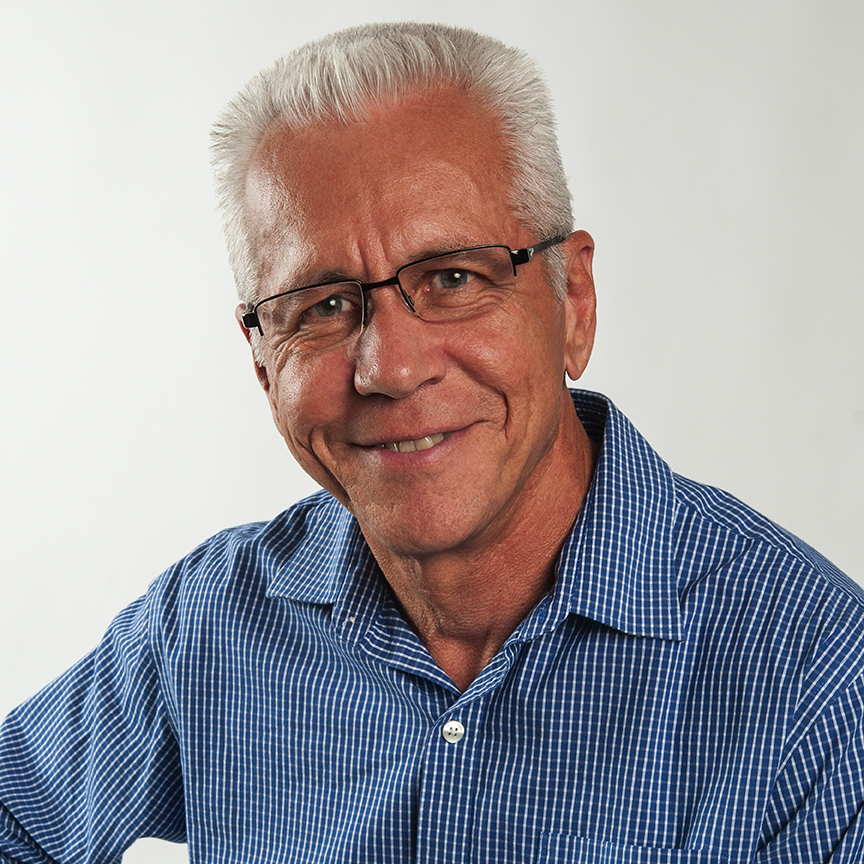
Rick Bowman’s qualifications include:
His training and consultation background has included mental health and human service agencies, non-profits, and corporations, as well as speaking/consulting internationally in Russia, Cuba, and Jamaica.
Rick has been employed as a Clinical Psychologist, Community College Professor, Assistant Principal, Alternative School Director, Student Services Director, and non-profit Assistant Executive Director. His recent implementations of CPS have been:
— With children in a non-profit alternative middle school and high school setting in the David Douglas School District in Southeast Portland where students face significant barriers to their social, emotional and educational progress such as homelessness, severe poverty, drug & gang involvement, and disengagement from school.
— With teens in a Long Term Care and Treatment school for students in Level 5 residential foster care who have experienced significant trauma.
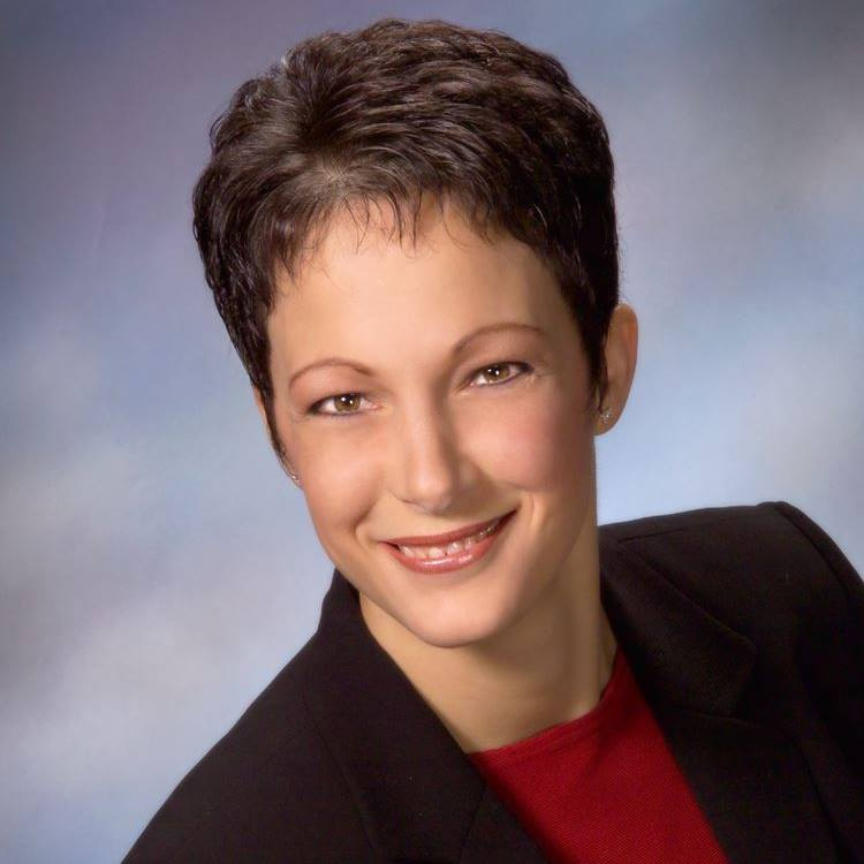
Doris Bowman’s qualifications include:
Doris has co-authored Going to Bed is Easy Now, and Going to School is Easy Now, the first two in a series of children’s’ books designed to support children with challenging behavior (www.easynowbooks.com). She has a broad background in special education and behavior consultation with over 20 years experience working with and supporting children with challenging behaviors and their families.
This training should be a requirement for anyone in a role who supports students and teachers, especially people who write or contribute to IEPs and other Student Support Plans.

Rick and Doris have written a guidebook for anyone who recognizes the shortcomings of traditional compliance based behavioral strategies and wants to shift their lens and professional practices to ensure supportive approaches for students are implemented.
Their well thought out sequence in the Your FBA is a Fantasy! helps educators go from fantasy to actionable plan.
I have had the great honor of working in person with Rick and Doris. With this guidebook, I can now have their wisdom, guidance, and encouragement at my fingertips whenever I need it.
Reading Your FBA is a Fantasy! felt like sitting in the front row at the Bowmans’ training! The content was easily accessible, engaging, and immediately applicable. The Bowmans beautifully blended current evidenced theories and practices such as Polyvagal Theory, Collaborative Problem Solving, and Heart Math, and demonstrated how the current science can be used to create transformative, student-centered FBAs and BSPs.
There is so much valuable information in Your FBA is a Fantasy! that whole pages were highlighted. It will be the first book study for Professional Learning this year.
You don’t have to figure this out alone. Every student deserves more than a plan on paper—and every educator deserves tools that bring hope back into the classroom. With Your FBA is a Fantasy!, we’ll help you walk the path toward classrooms where kids thrive—and where you can too.
We’ve poured everything into making sure you don’t just understand trauma-informed FBAs and behavior plans—you can actually DO them.
And when you do? The outcomes are powerful:
-
Students become more “academically available.”
-
Staff feel less like failures, and more like allies.
-
Schools shift form writing plan after plan… to seeing real progress.
No educator should have to reinvent the wheel.—And no child should be left with a plan that makes them feel broken.